Showing posts with label Nostalgia/Obsolescence. Show all posts

2.22.2012

Discount framing.

CFS & eggs @ Arkie's Grill, Austin, TX, via iPhone. © Ryan Schierling
"Where have you been, man?"
"I don't know. I don't... I don't know. 
"All I ever see of you is phone pics of food on Facebook? What's up?"
(I push my runny eggs around on the plate, pick up my coffee cup and look down into the blackness.)
"It's just someone else's art in my frame. Sometimes it's easier to make the frame."
"What?"
"Arkie made something beautiful here. And all I did was frame it."
"I'm not even sure Arkie's alive anymore. I think that Mexican line cook 'made' your art."
"Yeah. Maybe. Does our waitress sound Norwegian or Swedish... or Finnish to you?"
"What?"
"Nevermind."

8.10.2010

21 years and 627 miles.

(L) Gary, 1989. Emporia, Kansas. (R) Gary, 2010. Austin, Texas. © Ryan Schierling

6.14.2010

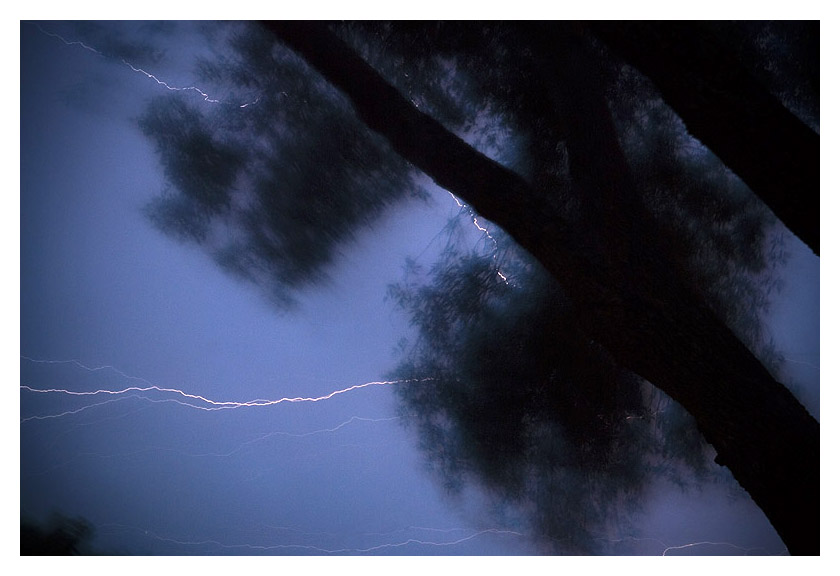
A photograph I cannot make, but dearly wish I could.

The lightning was pink tonight. © Ryan Schierling

I was in a small room. I had my camera with a wide-angle zoom and on-camera flash. There was a sofa bed, with the bed pulled out. The sheets and blankets were a mess. There were no pillows. I stood in the one-foot space between the sofa bed and the wall, pointing my camera at the opposite wall. There was a dark couch pushed up against the opposite wall, with a large window behind it. There were curtains on either side of the window. There was a one-foot space between the sofa bed and the couch. There was a bright red sleeping bag unrolled on the couch. There was no apparent light source in the room, but I recall it being dim. Desaturated, all but the bright red sleeping bag.

I stood with my back to the wall, pointing my camera at the window. I wanted the flash to fire, I wanted a hot spot and reflection of me in the window glass, with the mess of the foreground.

I shot one frame, I looked at the back of my digital camera display. The flash must not have fired, or there wasn't enough light output. I adjusted it from its manual setting of 1/32 to 1/16. I shot one frame, I looked at the back of my digital display. Again, it looked like the flash had not fired at all.

I adjusted from 1/16 to 1/2 power. I shot one frame, I looked down at the back of my digital display. Standing in the one foot space between the edge of the sofa bed and the dark couch with the bright red sleeping bag, with her hand on the window and looking back at me over her shoulder, was a woman exactly my age. Tall and thin, dark hair, barely shoulder length, wearing a black dress with buttons all the way up the front. I looked up from the camera, startled and stunned, scared. There was no one there.

I woke immediately with a chill that went from my head to my toes, a chill that did not leave me for a good five seconds. I still get that chill every time I tell this story.

I don't remember you, or know what we shared. We haven't been together for 38 years. But I am remembering you, somehow.


5.10.2010

7:47 AM.

She was born now, 38 years ago, the second of two. © Ryan Schierling

I was born now, 38 years ago, the first of two. © Ryan Schierling

As I grow older, these birthdays are either a celebration of the year to come, or a funeral for the previous year. There are times I don't know what to do with myself. I wander the house, from room to room, flipping light switches on and off again. I wonder how different things might be if she were here.

Whatever this day brings, she, and all of the paths that never had a chance to begin, are at the forefront of my thoughts.

4.26.2010

There are still analog signals out there, and they're looking for you.

(L) Defunct analog television tower atop Mt. Larson - Austin, Texas. (R) One working rabbit ear antenna, extended, 5" black-and-white television. (Click for larger image) © Ryan Schierling

As of June 11, 2009, the Federal Communications Commission put an end to all high-power analog terrestrial television transmissions in the United States. Television sets in some two million households went blank that date, as they were unprepared for the transition, despite Congress rolling back the shutdown by four months. The switch from analog to digital was designed to free up frequencies for public safety communications, and allow television stations to provide improved picture and sound quality, and more broadcast options for consumers.

In the middle of a warm summer night in 1978, I woke up downstairs in our giant brown upholstered chair. The house was dark and silent, and the 20" black-and-white television was on – visual static flickering across the walls and ceiling, soft aural static rousing me from a restless somnambulant state. It was 3 a.m., transmitters were shut off, there was nothing on TV but dead air. I turned off the set and went back upstairs to bed. I was six years old.

There is never anything on television. 23 hours of analog static and one Indian Head Test Pattern, photographed on a 5" black-and-white television. (Click for larger image) © Ryan Schierling

Most television stations are on 24-hour schedules now, with paid programming and infomercials filling the late-night and early-morning slots. There are no more formal sign-offs, no national anthems played or test patterns aired. On the majority of digital televisions, a silent, solid blue screen has replaced random, hissing analog static if a broadcast station or input cannot be located.

People are only nostalgic about things that they remember being better than they are now. Were the good old days really that good, or do we just whitewash the difficult returns home with fresh paint on worn and splintered wood? I tend to forget the bad, try to romanticize the good. There was a five-inch black-and-white television in the trash at work last week. I took it out, plugged it in, extended the single antenna and turned through the channels looking for something, anything out there. I needed an analog signal in a digital world, a reassuring hand on my shoulder from the past.

I got MTVtr3s. Sometimes you just can't go home again.

There are still viable analog signals out there – and they're always looking for us – but we're not paying attention. We are no longer of the past or even the present, but of the future. There isn't a need to look back.

There is always something on television. 24 hours of over-the-air analog broadcasting on Mexican UHF/VHF stations, photographed on a 5" black-and-white television. (Click for larger image) © Ryan Schierling

1.09.2009

Mullet, bb gun, and The Road.


Vamos camino de la muerte. Presbyterian Church parking lot. Emporia, Kansas. 1990. © Ryan Schierling